In preparation for Studio Brief 02 digital development and further studio briefs within OUGD403, undertake research into key theorists and systems used in the development and implementation of grids used within layouts and composition. You should aim to undertake primary and secondary reserach.
Deconstruct websites, newspapers, spreads etc to identify the use of grids and their purpose. Aim to identify links between use of typography and grid systems in context to the target audience and purpose of layout. Identify trends between column usage and word count.
Firstly I started by doing some very brief research into grids and some of the general definitions and characteristics of some of the basics of grids and layouts.
I thought a good place to start would be with a reminder of some of the terms I needed to learn.

Gris Systems;
A grid system is a system of which designers use to layout text, image and all components of any piece of design.
Grids help designers organise contents and provides consistency to their designs.
It is sometimes said good grid systems can be related to what is called the golden ratio or sometimes called the fibonacci sequence.
Grids became popular during the swiss movement called the bauhaus movement in the 1920s.
Manuscript Grid;
Structurally the simplest grid
Base structure is a large rectangular area that takes up the majority of the page.
Usually for extensive continuous text.
Has a secondary structure for headers and footers for the document.
The changing of the margins is the most changed aspect of this grid and it can have a subtle or dramatic effect.
Columnar Grid;
Information that isn't continuous benefits from being presented in this style as it benefits from being organised into an arrangement of vertical columns.
Very flexible and can be used to separate different parts of the information.
The width of the columns depends on how many columns are used per grid.
Modular Grid;
Modular grids allow for more control over more complex projects.
A modular grid is a column grid with large horizontal flow lines that sub divide the columns into rows.
The degree of control within the grid depends on the size of the modules.
Too many subdivides can become confusing or redundant
Modular grids are commonly used for charts, forms, schedules or navigation systems.
Modular grids are the grids of which are most commonly used

The fact that there is a belief that the golden ratio can be related to a lot of things around us is evident in many things around us in the world today stretching all the way from art to the fact it can be related to things in nature. This first thing that can be related to the golden ratio is something from nature;
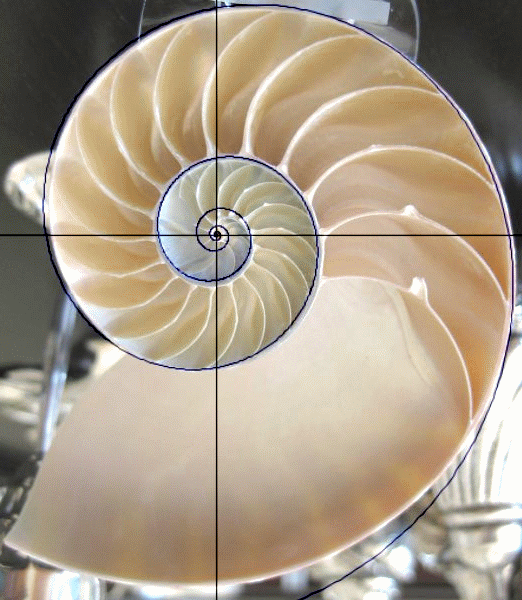
The most obvious evidence of the golden ration in nature is the way that a shell can fit perfectly to the golden ratios patter but could there actually be the golden ratio worked into the nature around us or is this just coincidence? An application of the golden ratio in the art world can be found in the the Mona Lisa. It is said that the golden ratio can be fit perfectly to the Mona Lisa and often debated whether Da Vinci intended it to be designed around the golden ratio or just the fact that as a good artist he knew what looked best and this by coincidence can be linked to the golden ratio. There are many modern day designs that can be related it to, for example the apple iCloud logo...

This diagram shows how the golden ratio applies to the logo. Whether all of these examples are by design or bu coincidence we will never know, the iCloud logo has been confirmed to not have been designed by the ratio so I wonder how can it be designed to closely to the golden ratio by accident? Whether or not work is designed around it I think the theory os a way to design of which will always make your design beautiful fascinating.
Another crucial part to grids and layout design of which is important to graphic design is various canons created as a guide to layout by famous graphics designers. The first of these is the Van De Graaff cannon,the second is Tschichold's drawing of an octavo format page and the third is Yan Tschicholds golden canon of construction;
  
These three layout formats are all grid layouts for text pages and all revolve around the way the golden ratio fits to the page. The use of these canons for page layout are present in commercial use for example the existence of these can be seen heavily to penguin books;

Here you can see an example of where I have put a picture of an iphone into photoshop and tried to apply a grid to it;
 |
Sunday, 16 November 2014
OUGD403 Study Task 2 - Grids,Layout and composition
For the starting point we were given a task to start us thinking about and researching in composition and layout, this was the task...

Subscribe to:
Post Comments (Atom)
No comments:
Post a Comment